In the House of the Wild
In the stillness of a Himalayan night, the wild stepped forward and asked me to listen.
My life had been one of constant motion — of packing and unpacking, a travel tale traipsing across many lands — so when I found the wooden house, reachable only by foot or horseback, I finally caught my breath and paused.
I lived alone in the large, two-storied house that stood like a sentinel at the entrance of the Great Himalayan National Park, but I was rarely alone. Animals roamed freely across the land my house sat upon, feasting on wild herbs and grasses that carpeted the ground. At the end of summer, just as the apples blushed crimson and bent the branches that had borne them, monkeys descended from the dense forest above to strip my trees bare. Horses and cows grazed as happily in sunshine as in rain, and many mornings I awoke to the tinkling of bells hanging from their necks. The Himalayan Monal—a bird of wild, vivid colors seemingly straight out of a child’s imagination—would glide through my garden as a rare, ocular treat, blissfully unaware of how dazzlingly psychedelic and awe-inspiring he was. And in that mystical forest, Himalayan giant flying squirrels crossed in and out of other dimensions.
The other animals who visited were the local dogs. Sometimes they came in packs, sometimes alone. We understood one another, speaking the language of the heart. Among them, I was known as a friend, a helper, an aid to their healing when needed.
One of my neighbors was a young, ivory-colored puppy who often came to visit. He lived with a Nepalese family down the hill. Because he had been spoiled by tourists who loved to feed him cookies and buttered chapatis, he had earned the name Raja, which means “king.”
One evening, on my way home from shopping in town, he followed me through the forest to my house. I lived on the second floor, while the first floor was used for storing firewood and tools. A narrow, rickety wooden staircase led to the front door. To the right of it was a small balcony. I led Raja to the balcony and told him he could stay there, assuring him that I would leave the front door open so he could see me.
As I ate dinner and watched a movie on my computer in the living room, Raja kept slipping into the house, sitting in the doorway and staring intently into the night. Each time, I ushered him back out, scolding him lightly. Finally, when I was ready for bed, I gave him good-night cuddles and left him on the balcony, closing the door. I had left him a bowl of water and a little food, though he seemed uncharacteristically uninterested.
At 4:20 a.m., I heard him yelp, followed by sounds of a scuffle. I bolted out of bed, grabbed my flashlight and the long stick I kept behind the door, and ran down the front steps. My instincts guided me through the darkness; I knew exactly where to find him. On the forest path that skirted my house, I found Raja lying on his side, blood smeared across his neck and hips. I couldn’t tell if he was alive—then I saw his side rise faintly. He was breathing. I thought I would have to carry him, but when I spoke his name, he leapt to his feet and staggered toward me. He was in shock.
In that moment, I felt we were being watched. I flashed my light into the trees and caught a glint of eyes—steady, patient, unblinking. There were no thoughts then, only knowing and action.
We turned away and walked back toward the house. Raja managed to climb the stairs with a little help. I opened the door leading from the balcony into my small prayer room and told him to stay outside. I worried he would get blood everywhere if he came in. But he feared the balcony and kept slipping inside, staring into the night as he had before. I faced the house, my back to the darkness from which we had just come. His sudden alertness—wide-eyed with his nose lifted and sniffing—made me spin around and point my flashlight into the void.
Beneath the balcony, the gleaming eyes stared up at us. I heard the animal’s voice in my mind: I have come for my dinner. I quickly stepped inside with Raja and bolted the door.
He trembled and whined softly, never taking his eyes from the closed door. When I examined his wounds, I saw the clear marks of a wild cat—teeth sunk into his neck, claws gripping above his hips. The cuts were deep, especially around the throat. I cleaned them as best I could with the few supplies I had, knowing I’d call a veterinarian friend in the morning.
I made us both a pallet on the floor and held him close as we tried to sleep. He shook and twitched most of the night. Come late morning, I finally felt him relax into slumber.
When we rose late the next day, he still refused food and water. So entrenched in fear and anxiety, he searched with wide, wild eyes for the one who had attacked him hours before. I cleaned and dressed his wounds several times, but the deep one beneath his chin was beginning to look worse. I stayed near him all day, speaking to him whenever I moved from room to room so he’d know I was close. Sometimes he followed me, but mostly he lay on the cozy bed I’d made for him.
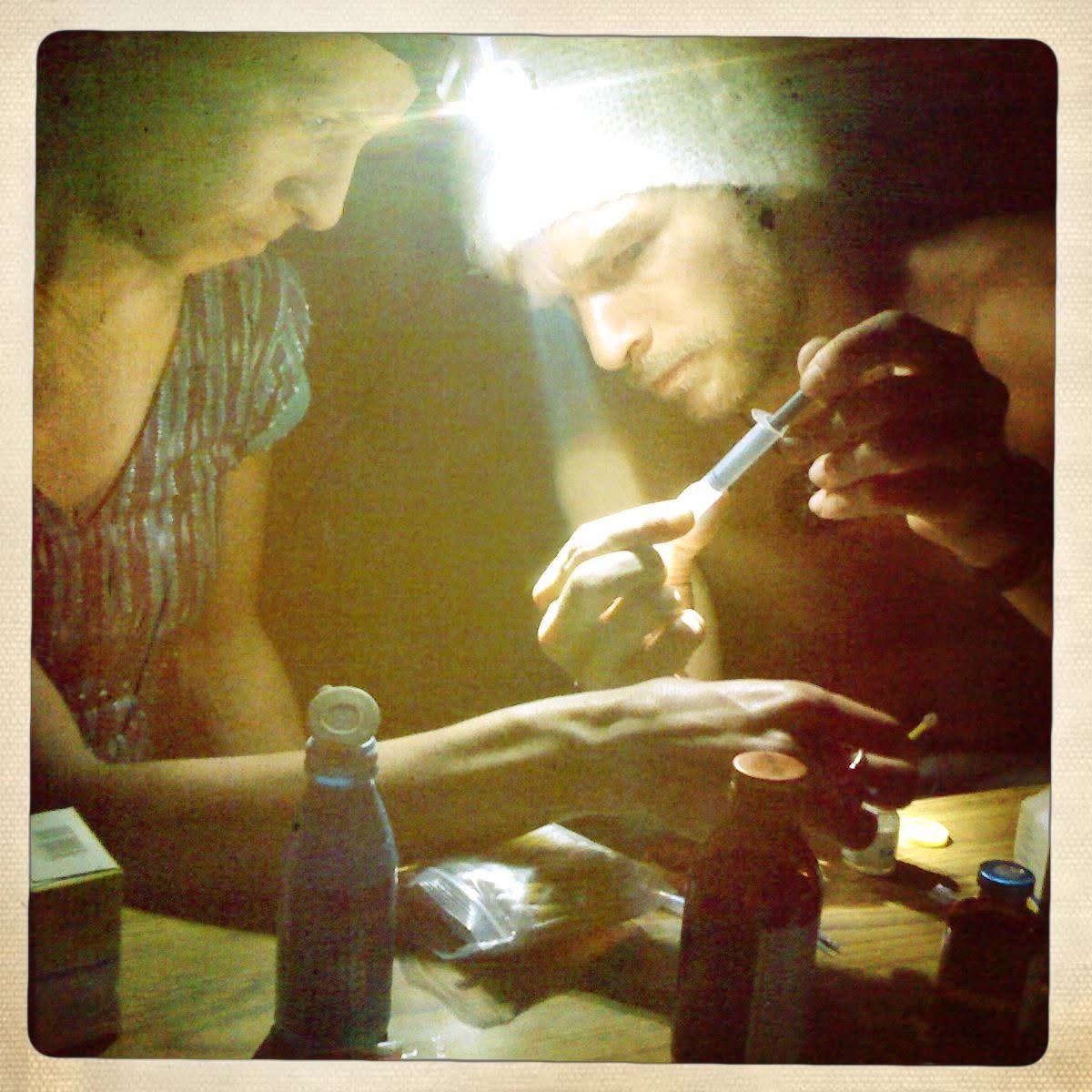
That evening I called my friend’s brother, Dakpa, a newly graduated veterinarian. He told me what medicines to buy. I described Raja’s shaking and the oozing wound on his neck. Dakpa suspected infection and advised me to get syringes for subcutaneous injections of antibiotics and painkillers. “Watch a few videos online,” he said. “It’s easy.” He walked me through the steps, but I knew I’d need to see it before I could do it confidently.
I realized I couldn’t leave Raja alone in the house while I went to town—he’d feel abandoned and frightened. I called two friends, Katherine and Roman, who had gone to the next valley for a romantic getaway. I felt guilty asking them to return, but when I told them what had happened with our canine friend, they didn’t hesitate.
They arrived early the next day. As they settled into my guest room, I hiked down to Kasol to buy medical supplies and watch the instructional videos.
Raja stayed with me for a week, as did Katherine and Roman. The four of us fell into a simple rhythm centered around Raja’s care. He began to feel safe, and his wounds started to heal. It took several days before he dared to step outside. The first time he did, he pressed his body against my legs, sniffing the air nervously. We built a fire as the forest darkened with the night. Raja slept in my lap while Roman played his steel-stringed guitar.
After I took Raja back home, Katherine and Roman left too. I was alone again, and grateful for the muted mundanity.
A few days later, one of the local women came to my house looking for a baby calf who had wandered away from his mother. I told her I hadn’t seen him, and she continued calling into the forest. The next day, the calf’s body was found in the field next to my house. The cat had claimed him. He had finally found his dinner.
In the weeks afterward, the air around the house felt charged — as if the forest itself remembered. I often thought about the night the cat came for his dinner. Life in those mountains was wild, unfiltered, and exact in its exchange — one creature’s fear, another’s hunger, the delicate balance between mercy and survival. Yet in the middle of it all, love had staked its quiet claim: a traumatized dog who trusted me, my heart that answered without hesitation.